Repeated failed IUI cycles can feel overwhelming. At first, hope remains strong. However, after multiple attempts, confusion and stress begin to increase.
At this stage, many couples start asking an important question — should we continue IUI or switch to IVF?
This decision requires medical clarity. Therefore, understanding the difference between IUI and IVF helps you move forward with confidence and better chances of success.
Understanding IUI Treatment and Its Success Rate
Intrauterine insemination (IUI) is often the first step in fertility treatment. It is a simple and less invasive procedure.
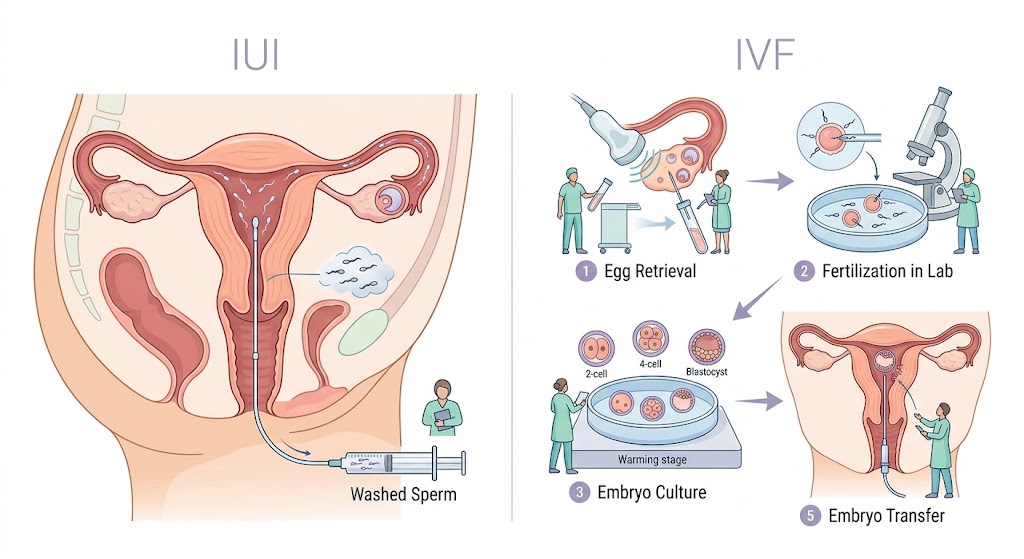
During IUI, doctors place prepared sperm directly inside the uterus during ovulation. This increases the chances of fertilization naturally.
Doctors usually recommend IUI for:
- Mild male infertility
- Unexplained infertility
- Ovulation issues
Although IUI is affordable and easy, its success rate per cycle remains limited. On average, it ranges between 10–20%, depending on age and medical condition.
Because of this, repeated cycles may not always improve the outcome.
Why Do Multiple IUI Cycles Fail? Key Medical Reasons
When IUI fails repeatedly, there are usually underlying causes. Identifying these reasons is important before continuing treatment.
Egg Quality Decline
As age increases, egg quality decreases. This directly affects fertilization.
Fallopian Tube Issues
IUI depends on open fallopian tubes. Even a small blockage can reduce success.
Low Ovarian Reserve
Low AMH levels indicate fewer eggs. As a result, treatment response becomes weaker.
Male Factor Infertility
Poor sperm quality can prevent fertilization.
Endometriosis
This condition affects both fertilization and implantation.
Uterine Conditions
Fibroids or polyps can stop embryo attachment.
Because of these issues, continuing IUI without deeper evaluation may delay better treatment options.
How Many IUI Attempts Are Recommended Before IVF?
Most fertility specialists suggest trying 3 to 4 IUI cycles.
After that:
- Success rates do not increase significantly
- Time becomes an important factor
- Further evaluation is required
Therefore, switching to IVF after multiple failed IUI cycles often becomes the right step.
IUI vs IVF: Key Differences That Matter
IUI and IVF differ in process and effectiveness.
- IUI allows fertilization inside the body
- IVF performs fertilization in a lab
IVF is more advanced. It gives doctors better control over fertilization and embryo selection.
As a result, IVF offers higher success rates, especially in complex fertility cases.
When Should You Switch from IUI to IVF?
Doctors usually recommend IVF if:
- Three or more IUI cycles have failed
- Age is above 35
- AMH levels are low
- Fallopian tubes are blocked
- Severe male infertility exists
- Endometriosis is diagnosed
In such situations, IVF significantly improves the chances of pregnancy.
Why IVF Works Better After Failed IUI Cycles
IVF offers a more controlled approach.
Doctors retrieve eggs and fertilize them in a lab. Then, they transfer the healthiest embryo into the uterus.
This process avoids many natural barriers like blocked tubes or poor sperm movement.
Advanced techniques such as ICSI also help in cases of male infertility.
According to the American Society for Reproductive Medicine, advanced fertility treatments like IVF improve success rates in cases where simpler methods fail.
Because of these advantages, IVF becomes more effective after repeated IUI failures.
IVF Success Rate After Multiple Failed IUI Attempts
IVF success rates are much higher compared to IUI.
- First IVF cycle: around 50–65% success
- Multiple cycles: even higher cumulative success
However, results depend on age, diagnosis, and treatment quality.
Early transition to IVF can improve overall outcomes.
Emotional Impact of Repeated IUI Failure
Repeated failures can affect mental well-being. Many couples experience stress, anxiety, and disappointment.
However, it is important to understand that fertility challenges are medical conditions.
Seeking expert guidance and emotional support can help you stay positive and make informed decisions.
Questions to Ask Before Switching to IVF
Before making a decision, you should discuss your case in detail with your doctor.
Ask questions like:
- Why did IUI fail in my case?
- Do I need further tests?
- What are my IVF success chances?
- How should I prepare for IVF?
These answers will guide your next step clearly.
Expert Fertility Care in Noida – Dr. Aprajita Srivastava
Choosing the right fertility expert plays a key role in treatment success.
Dr. Aprajita Srivastava is a highly skilled gynecologist, IVF specialist, and laparoscopic surgeon based in Sector 121, Noida. She has extensive experience in reproductive medicine and advanced fertility treatments.
If you are facing repeated failures, consulting an infertility specialist in Noida can help you identify the exact cause and choose the right treatment plan.
She provides advanced care at a leading IVF center in Noida, where modern techniques are used to improve success rates after failed IUI cycles.
Patients also consult her as the best gynecologist in Noida for complete reproductive care and high-risk pregnancy management.
Before starting IVF, it is important to understand how to prepare for IVF treatment to improve your chances of success.
With a personalized approach and advanced expertise, Dr. Aprajita Srivastava helps couples move forward with confidence and clarity.