Implantation is a critical step in early pregnancy. It connects the embryo to the uterus. Many people ask how long implantation takes and when it happens. The answer is not a single fixed number. It follows a biological timeline.
In most cases, implantation starts around 6 to 10 days after ovulation. The full process can take 2 to 4 days. This includes attachment and embedding into the uterine lining.
Understanding this process helps reduce confusion. It also helps in tracking early pregnancy signs.
What is Implantation?
Implantation is when a fertilised egg attaches to the uterus lining. This lining is called the endometrium. It becomes thick during the menstrual cycle. This prepares the body for pregnancy.
After fertilisation, the egg becomes a group of cells. This is called a blastocyst. It travels from the fallopian tube to the uterus. This journey takes a few days.
Once the blastocyst reaches the uterus, it begins the implantation process. It attaches to the lining and starts receiving nutrients. This step is essential for pregnancy to continue.
At this stage, the body begins producing the hormone hCG. This hormone is detected in pregnancy tests. It supports early pregnancy development.
If implantation does not happen, the body sheds the uterine lining. This leads to a menstrual period.
Implantation: When Does It Occur?
Implantation does not happen immediately after fertilisation. It follows a sequence of events. Each step takes time.
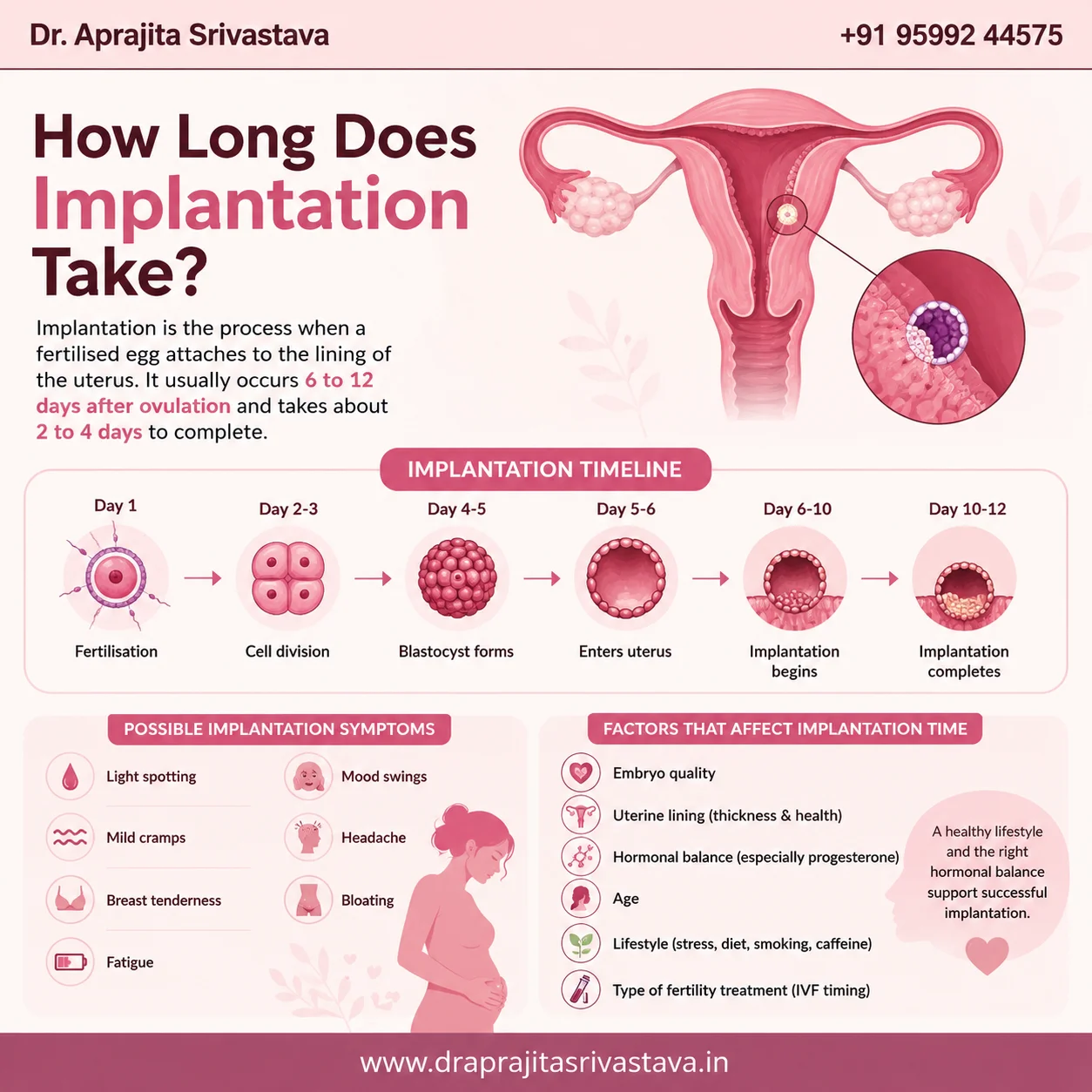
Here is a simplified implantation timeline:
- Day 1: Fertilisation occurs in the fallopian tube
- Day 2–3: The fertilised egg divides into multiple cells
- Day 4–5: A blastocyst forms
- Day 5–6: The blastocyst enters the uterus
- Day 6–10: Implantation begins
- Day 10–12: Implantation completes
This timeline can vary slightly. Some women may experience earlier or later implantation. Small variations are normal.
The timing also depends on the menstrual cycle. Implantation usually occurs during the luteal phase. This is the phase after ovulation.
To understand how timing works in your cycle, you can read about menstrual cycle phases and pregnancy.
How Long Does Implantation Take?
Implantation is not a one-day event. It is a gradual process. It involves several steps.
The complete process usually takes 2 to 4 days. It starts when the embryo first touches the uterine lining. It ends when it is fully embedded.
This duration can vary depending on:
- Embryo development
- Uterine lining condition
- Hormonal balance
Some embryos implant quickly. Others take more time. Both can be normal.
Late implantation may occur in some cases. This can shift the timing of pregnancy detection.
Stages of Implantation
Implantation happens in three main stages. Each stage plays an important role.
1. Apposition (Initial Contact)
This is the first step. The blastocyst reaches the uterus. It comes close to the uterine lining.
At this stage, the embryo is not firmly attached. It moves slightly to find a suitable spot.
The uterine lining must be receptive. Hormones like progesterone help prepare it.
2. Adhesion (Attachment)
In this stage, the embryo attaches to the uterine lining. Special cells called trophoblasts help in this process.
These cells create a connection between the embryo and the uterus. This step may take several hours to one day.
The attachment must be stable. A weak attachment may affect implantation success.
3. Invasion (Embedding)
This is the final stage. The embryo moves deeper into the uterine lining.
The trophoblast cells grow into the endometrium. Blood vessels begin to support the embryo.
Nutrients and oxygen are supplied. This helps the embryo grow.
At this point, hCG hormone production increases. This is when pregnancy can be detected.
For a deeper understanding of implantation in assisted reproduction, you can read implantation during IVF.
What Affects Implantation Timing?
Implantation timing is not the same for everyone. Several factors influence it.
Embryo Quality
A healthy embryo has better chances of implanting on time. Poor quality embryos may take longer or may not implant.
Uterine Lining
The thickness and health of the endometrium are important. A well-prepared lining supports implantation.
Hormonal Balance
Progesterone plays a key role. It prepares the uterus for implantation. Low levels can affect timing.
You can learn more about this from role of progesterone in early pregnancy.
Age
Age can influence egg quality. This may affect embryo development and implantation timing.
Lifestyle Factors
Stress, smoking, and poor diet may impact hormonal balance. This can delay implantation.
Fertility Treatments
In IVF cycles, implantation timing may differ. It depends on the day of embryo transfer.
If you want to explore treatment options, you can visit an infertility specialist in Noida.
Early Signs Linked to Implantation
Some women may notice early signs. Others may not feel anything. Both are normal.
Common early signs include:
- Light spotting
- Mild abdominal cramps
- Fatigue
- Breast tenderness
- Feeling bloated
These signs are caused by hormonal changes. They are usually mild.
Spotting during implantation is often confused with periods. To understand the difference, you can read implantation bleeding vs period.
In many cases, there are no clear symptoms. This is also normal.
Implantation vs Period: Key Differences
Implantation symptoms can feel similar to a period. This creates confusion. Understanding the difference helps avoid misinterpretation.
| Feature | Implantation | Period |
|---|---|---|
| Bleeding | Light spotting | Moderate to heavy flow |
| Color | Pink or brown | Bright or dark red |
| Duration | 1–2 days | 3–7 days |
| Pain | Mild cramps | Stronger cramps |
Implantation bleeding is lighter. It does not increase in flow. Period bleeding usually becomes heavier over time.
For a more detailed explanation, you can read implantation bleeding vs period.
Implantation Timeline in IVF
Implantation timing changes in IVF cycles. It depends on the stage of embryo transfer.
In Day 3 embryo transfer:
- Implantation may begin around 3–5 days after transfer
In Day 5 blastocyst transfer:
- Implantation may begin within 1–2 days after transfer
This difference happens because Day 5 embryos are more developed.
The implantation window remains important in IVF. Proper timing improves success chances.
You can explore more about this process in implantation during IVF.
Can Implantation Happen Late?
Yes, implantation can happen later than expected. This is called late implantation.
Late implantation may occur after 10–12 days post ovulation. It can delay positive pregnancy test results.
Reasons for late implantation may include:
- Slow embryo development
- Hormonal imbalance
- Uterine lining conditions
Late implantation does not always mean a problem. However, very late implantation may need medical evaluation.
What If Implantation Fails?
Implantation failure means the embryo does not attach to the uterus. This leads to a menstrual cycle.
Possible causes include:
- Poor embryo quality
- Thin uterine lining
- Hormonal imbalance
- Immune or genetic factors
Repeated implantation failure may need medical support.
If you are facing repeated issues, you can consult an infertility specialist for evaluation.
When Can You Take a Pregnancy Test?
Timing of the test matters. Testing too early may give false results.
After implantation, hCG hormone starts rising. It takes time to reach detectable levels.
Most reliable time for testing:
- 10–14 days after ovulation
- Or after a missed period
Early testing may show negative results even if implantation has occurred.
Myths and Facts About Implantation
Myth: Implantation always causes bleeding
Fact: Many women do not notice any spotting
Myth: You can feel implantation clearly
Fact: Most symptoms are mild or unnoticed
Myth: Late implantation always means a problem
Fact: Small variations in timing are common
Myth: Strong cramps mean implantation
Fact: Implantation cramps are usually mild
Practical Tips During Implantation Window
Simple habits can support early pregnancy health.
- Maintain a balanced diet
- Stay hydrated
- Avoid smoking and alcohol
- Reduce stress levels
- Follow proper sleep routine
Nutrition plays a role in fertility. You can read about diet for fertility support.
When to See a Doctor
Medical advice may be needed in some situations.
- Repeated implantation failure
- Irregular cycles
- Severe pain or heavy bleeding
- Difficulty conceiving
Early consultation helps in proper diagnosis and treatment.
You can also check signs to consult a gynecologist.
About the Expert
Dr. Aprajita Srivastava is a highly skilled gynecologist, IVF specialist, and laparoscopic surgeon based in Sector 121, Noida. She has strong experience in reproductive medicine and infertility care. She manages complex fertility cases and high-risk pregnancies. She performs advanced procedures like IVF, IUI, and egg freezing.
Dr. Aprajita Srivastava, IVF Specialist in Noida, Best Gynaecologist in Noida
Phone : +91 95992 44575
Address: Ofc No 143, 1st Floor, QURE CLINIC, Cleo St, Sector 121, Noida, Uttar Pradesh 201301
https://maps.app.goo.gl/xKC5rTW5NfitCmBF6
Her clinical approach focuses on accurate diagnosis and patient-specific treatment planning.
Final Words
Implantation is a gradual process. It usually happens within a specific timeframe after ovulation. The process may vary slightly from person to person.
Understanding implantation helps in better pregnancy planning. It also reduces unnecessary stress during early stages.
If you have concerns about implantation or fertility, professional guidance can help you move forward with clarity.