
Many women struggle with infertility without knowing the real cause. One often overlooked factor is autoimmune thyroid disease. This condition can affect hormone balance, ovulation, implantation, and pregnancy outcomes.
The thyroid gland plays an important role in reproductive health. It helps regulate metabolism, menstrual cycles, and hormone production. When the immune system attacks the thyroid gland, fertility problems can develop.
Fertility challenges in women with autoimmune thyroid disease are becoming increasingly recognized. Research shows that thyroid disorders can reduce the chances of conception and increase the risk of miscarriage.
If you are trying to conceive and have thyroid issues, understanding this connection is important. Early diagnosis and proper treatment can significantly improve fertility outcomes.
What Is Autoimmune Thyroid Disease?
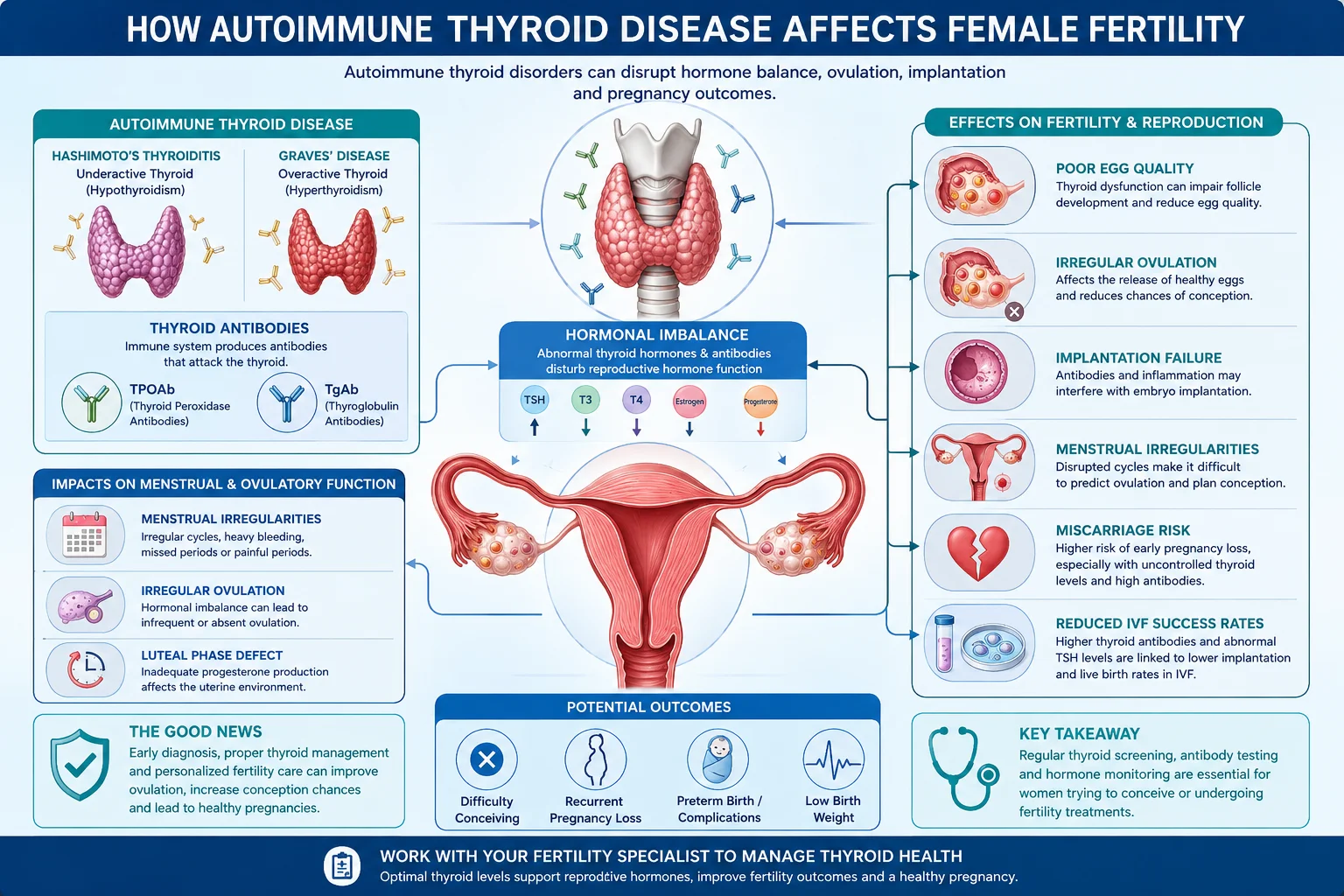
Autoimmune thyroid disease occurs when the body’s immune system mistakenly attacks the thyroid gland.
The two most common types are:
- Hashimoto’s Thyroiditis – Causes hypothyroidism or an underactive thyroid.
- Graves’ Disease – Causes hyperthyroidism or an overactive thyroid.
Both conditions can affect reproductive hormones. As a result, women may experience fertility challenges in women with autoimmune thyroid disease.
Why Is the Thyroid Important for Fertility?
The thyroid gland produces hormones that help regulate many functions in the body. These hormones also interact with reproductive hormones such as estrogen, progesterone, FSH, and LH.
Healthy thyroid function supports:
- Regular ovulation
- Healthy menstrual cycles
- Egg development
- Embryo implantation
- Pregnancy maintenance
When thyroid hormone levels become abnormal, fertility can be affected at multiple stages.
How Autoimmune Thyroid Disease Affects Female Fertility
Irregular Ovulation
Ovulation is essential for natural conception. Thyroid hormone imbalance can interfere with the release of an egg from the ovary.
Some women ovulate less frequently. Others may stop ovulating altogether.
This is one of the most common fertility challenges in women with autoimmune thyroid disease.
Menstrual Cycle Problems
Women with thyroid disorders often experience menstrual irregularities.
Common symptoms include:
- Heavy periods
- Missed periods
- Irregular cycles
- Painful periods
- Short or long cycles
These changes may signal an underlying hormonal imbalance that requires medical evaluation.
Reduced Egg Quality
Thyroid hormones help support healthy egg development.
When thyroid function is impaired, egg quality may decline. Poor egg quality can reduce fertilization rates and embryo quality.
Women planning pregnancy can also explore natural ways to improve egg quality while managing thyroid health.
Implantation Failure
Fertilization is only one step in the pregnancy journey.
The embryo must successfully attach to the uterine lining. Autoimmune activity and thyroid antibodies may interfere with this process.
This can increase the risk of implantation failure and unsuccessful pregnancy attempts.
Thyroid Antibodies and Infertility
Many women with autoimmune thyroid disease have elevated thyroid antibodies.
The most common antibodies are:
- Thyroid Peroxidase Antibodies (TPOAb)
- Thyroglobulin Antibodies (TgAb)
These antibodies may be present even when thyroid hormone levels appear normal.
Studies suggest that positive thyroid antibodies are associated with:
- Difficulty conceiving
- Implantation failure
- Recurrent miscarriage
- Reduced IVF success
For this reason, antibody testing is often recommended during fertility evaluations.
Autoimmune Thyroid Disease and IVF Success Rates
Thyroid health plays an important role in assisted reproductive treatments.
Women undergoing IVF treatment should have their thyroid function carefully monitored.
Uncontrolled thyroid disease may reduce implantation rates and increase miscarriage risk.
Many fertility specialists recommend maintaining a TSH level below 2.5 mIU/L before conception.
Proper thyroid management can improve IVF success rates and pregnancy outcomes.
Women seeking advanced fertility care can benefit from consulting an experienced team at an IVF Center in Noida.
Silent Endometriosis and Its Impact on IVF Success Rates
Another hidden cause of infertility is endometriosis.
Many women have no symptoms. This condition is known as silent endometriosis.
Silent Endometriosis and Its Impact on IVF Success Rates is an important topic because it often goes undiagnosed.
Silent endometriosis can affect:
- Egg quality
- Embryo development
- Implantation
- Pregnancy success
Women with autoimmune conditions may also experience higher levels of inflammation. This can further affect fertility outcomes.
Understanding endometriosis is important when evaluating unexplained infertility.
Can Autoimmune Thyroid Disease and PCOS Occur Together?
Yes. Many women have both conditions.
PCOS and autoimmune thyroid disease share several symptoms. These include irregular periods, weight gain, and ovulation problems.
The combination can make conception more difficult.
Understanding the relationship between PCOS and fertility helps create a more effective treatment plan.
Pregnancy Risks Associated with Autoimmune Thyroid Disease
Pregnancy can still be achieved successfully. However, untreated thyroid disease increases certain risks.
- Miscarriage
- Preterm birth
- Preeclampsia
- Placental complications
- Growth restriction in the baby
Women with a history of recurrent pregnancy loss should undergo detailed thyroid testing.
Those who have experienced repeated miscarriages may require specialized fertility care.
Diagnosis and Treatment
Doctors may recommend the following tests:
- TSH
- Free T3
- Free T4
- TPO antibodies
- Thyroglobulin antibodies
- AMH
- FSH and LH
- Pelvic ultrasound
Treatment depends on the underlying condition.
Women with hypothyroidism are usually treated with thyroid hormone replacement therapy.
Women with hyperthyroidism may require medication and close monitoring.
Additional infertility treatment options may include ovulation induction, IUI, or IVF.
Expert Fertility Care by Dr. Aprajita Srivastava
Dr. Aprajita Srivastava is a highly skilled gynecologist, IVF specialist, and laparoscopic surgeon in Noida.
She specializes in infertility treatment, IVF, IUI, egg freezing, and reproductive medicine.
Her expertise helps women identify hidden fertility problems and receive personalized treatment plans.
Phone: +91 95992 44575
Address: Ofc No 143, 1st Floor, QURE CLINIC, Cleo St, Sector 121, Noida, Uttar Pradesh 201301
Conclusion
Fertility challenges in women with autoimmune thyroid disease can affect ovulation, implantation, IVF outcomes, and pregnancy success.
The good news is that most thyroid-related fertility issues can be managed with timely diagnosis and appropriate treatment.
If you are struggling to conceive, consulting an experienced infertility specialist in Noida can help identify the underlying cause and improve your chances of achieving a healthy pregnancy.