
Embryo grading is one of the most important steps in the IVF process. It helps fertility specialists identify embryos with the highest potential for implantation and pregnancy. Understanding The Science Behind Embryo Grading in IVF Treatment can help couples make informed decisions and set realistic expectations during their fertility journey.
Many patients assume that embryo grading guarantees IVF success. However, embryo grading is only one part of the equation. Factors such as age, egg quality, sperm quality, uterine receptivity, and overall reproductive health also play significant roles.
At a modern IVF Center in Noida, embryo grading is used alongside advanced fertility technologies to improve treatment outcomes and support personalized fertility care.
What Is Embryo Grading in IVF?
Embryo grading is a scientific process used by embryologists to assess the quality and development of embryos created during IVF. The goal is to identify embryos that have the highest chance of implantation and healthy pregnancy development.
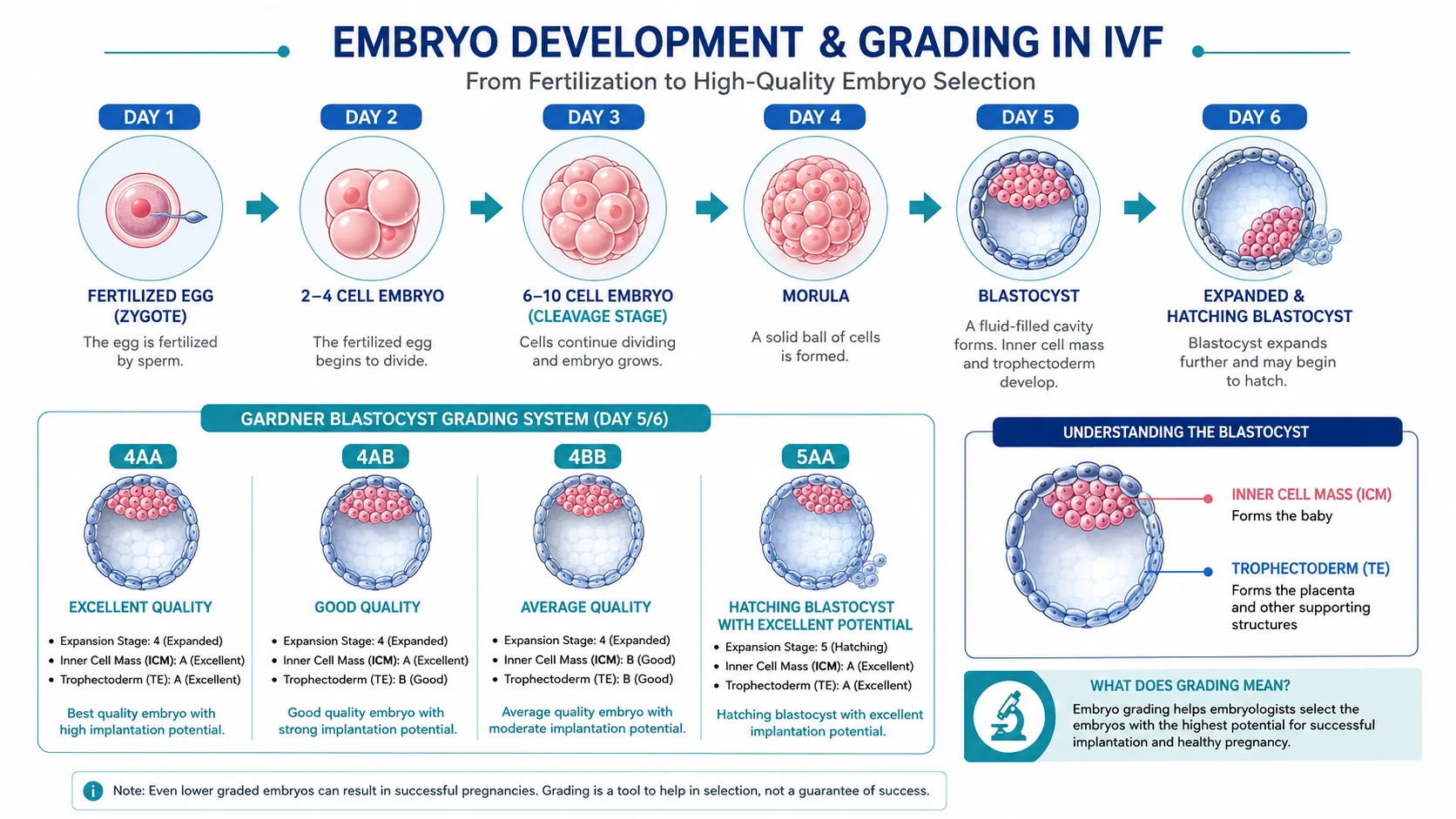
The Science Behind Embryo Grading in IVF Treatment focuses on evaluating cell growth, symmetry, fragmentation, and blastocyst development. These characteristics help fertility specialists determine which embryos should be transferred or frozen for future use.
If you are new to fertility treatment, understanding what IVF is and how it works can provide useful background before learning about embryo grading.
Where Does Embryo Grading Fit in the IVF Process?
Embryo grading takes place after fertilization and before embryo transfer.
- Ovarian stimulation
- Egg retrieval
- Fertilization
- Embryo development
- Embryo grading
- Embryo transfer
- Pregnancy testing
Patients preparing for fertility treatment often benefit from learning about how to prepare for IVF treatment before beginning the process.
Embryo Development Timeline
| Day | Development Stage |
|---|---|
| Day 1 | Fertilized Egg (Zygote) |
| Day 2 | 2–4 Cell Embryo |
| Day 3 | 6–10 Cell Embryo |
| Day 4 | Morula |
| Day 5–6 | Blastocyst |
Understanding this developmental journey is essential when discussing The Science Behind Embryo Grading in IVF Treatment.
Day 3 Embryo Grading
Day 3 embryos are called cleavage-stage embryos. At this stage, embryologists evaluate the number of cells, cell symmetry, and fragmentation.
A healthy Day 3 embryo typically contains 6 to 10 cells. Embryos with evenly sized cells and minimal fragmentation are usually considered better quality.
Fragmentation refers to small cellular fragments that appear during cell division. Excessive fragmentation may reduce developmental potential.
Day 5 Blastocyst Grading
Day 5 embryos reach the blastocyst stage. This stage provides more information about embryo quality.
Blastocysts contain two important structures:
- Inner Cell Mass (ICM) – develops into the baby.
- Trophectoderm (TE) – develops into the placenta.
The Science Behind Embryo Grading in IVF Treatment becomes more accurate at this stage because embryologists can evaluate these critical components.
Understanding the Gardner Blastocyst Grading System
The Gardner grading system is one of the most commonly used methods worldwide.
Embryos may be graded as:
- 4AA
- 5AA
- 4AB
- 3BB
Expansion Stage
The number represents the level of blastocyst expansion.
- 1–2 = Early blastocyst
- 3–4 = Expanded blastocyst
- 5 = Hatching blastocyst
- 6 = Fully hatched blastocyst
Inner Cell Mass Grade
The first letter evaluates the quality of the inner cell mass.
- A = Excellent
- B = Good
- C = Lower quality
Trophectoderm Grade
The second letter evaluates placental cell quality.
- A = Excellent
- B = Good
- C = Lower quality
For example, a 5AA embryo is generally considered a high-quality embryo.
Day 3 vs Day 5 Embryo Grading
| Factor | Day 3 | Day 5 |
|---|---|---|
| Development Stage | Cleavage Stage | Blastocyst Stage |
| Accuracy | Moderate | Higher |
| Implantation Potential | Lower | Higher |
Does a High-Grade Embryo Guarantee Pregnancy?
No. This is one of the biggest myths surrounding IVF.
The Science Behind Embryo Grading in IVF Treatment shows that grading only evaluates appearance and development. It does not guarantee implantation or live birth.
Successful pregnancy also depends on:
- Female age
- Egg quality
- Sperm quality
- Hormonal balance
- Uterine receptivity
- Overall reproductive health
Women concerned about age-related fertility challenges can learn more about the connection between age and infertility.
Embryo Grading vs Genetic Testing
Embryo grading and genetic testing serve different purposes.
| Embryo Grading | Genetic Testing |
|---|---|
| Visual assessment | Chromosomal assessment |
| Evaluates appearance | Evaluates genetic health |
| Cannot identify chromosomal abnormalities | Can detect many genetic abnormalities |
Many fertility specialists combine grading with Preimplantation Genetic Testing (PGT) to improve embryo selection.
Factors That Affect Embryo Quality
Several factors influence embryo quality.
- Female age
- Egg quality
- Sperm quality
- PCOS
- Endometriosis
- Obesity
- Lifestyle factors
- Hormonal imbalances
Women with PCOS may benefit from understanding how PCOS affects female fertility.
Similarly, obesity can significantly influence IVF outcomes. Learn more about the relationship between obesity and female infertility.
Silent Endometriosis and IVF Success Rates
One commonly overlooked factor is Silent Endometriosis and Its Impact on IVF Success Rates.
Silent endometriosis may affect egg quality, embryo development, implantation, and overall fertility outcomes. Because symptoms are often minimal, many women remain undiagnosed until fertility evaluations begin.
Women experiencing fertility challenges should also understand endometriosis symptoms, diagnosis, and treatment options.
How Embryo Grading Affects Implantation Success?
Embryo grading helps identify embryos with stronger implantation potential.
However, implantation depends on both embryo quality and uterine receptivity.
You can learn more about implantation during IVF and how the uterus supports pregnancy.
Some patients may also benefit from advanced testing such as the Endometrial Receptivity Array (ERA).
Expert Insights from Dr. Aprajita Srivastava
Dr. Aprajita Srivastava is a highly skilled gynecologist, IVF specialist, and laparoscopic surgeon based in Sector 121, Noida. She has extensive expertise in reproductive medicine, infertility treatments, IVF, IUI, egg freezing, and advanced fertility care.
As a trusted Best Gynaecologist in Noida, experienced IVF Specialist in Noida, and expert in Laparoscopic Surgery in Noida, she emphasizes that embryo grading should always be evaluated alongside patient age, fertility history, hormone levels, and uterine health.
Phone: +91 95992 44575
Address: Ofc No 143, 1st Floor, QURE CLINIC, Cleo St, Sector 121, Noida, Uttar Pradesh 201301
Frequently Asked Questions
What is embryo grading in IVF?
Embryo grading is the process of evaluating embryo quality based on development and appearance.
Is a 4AA embryo good?
Yes. A 4AA embryo is generally considered a high-quality blastocyst.
Can a low-grade embryo result in pregnancy?
Yes. Many lower-grade embryos have resulted in healthy pregnancies.
Does embryo grading predict IVF success?
It provides useful guidance but does not guarantee pregnancy.
Conclusion
The Science Behind Embryo Grading in IVF Treatment helps fertility specialists identify embryos with the highest developmental potential. While grading is an important tool, successful IVF outcomes depend on multiple factors.
A personalized treatment approach, advanced fertility technology, and expert reproductive care can significantly improve the chances of success.