Infertility affects millions of couples worldwide. Fortunately, modern fertility treatments offer effective solutions to help couples achieve their dream of parenthood. Among the most commonly recommended assisted reproductive technologies are IVF (In Vitro Fertilization) and ICSI (Intracytoplasmic Sperm Injection).
Many couples often wonder, “IVF vs ICSI: Which Fertility Treatment Is Better for You?” The answer depends on several factors, including age, fertility diagnosis, sperm quality, egg quality, and previous treatment history. Understanding the difference between IVF and ICSI can help you make an informed decision.
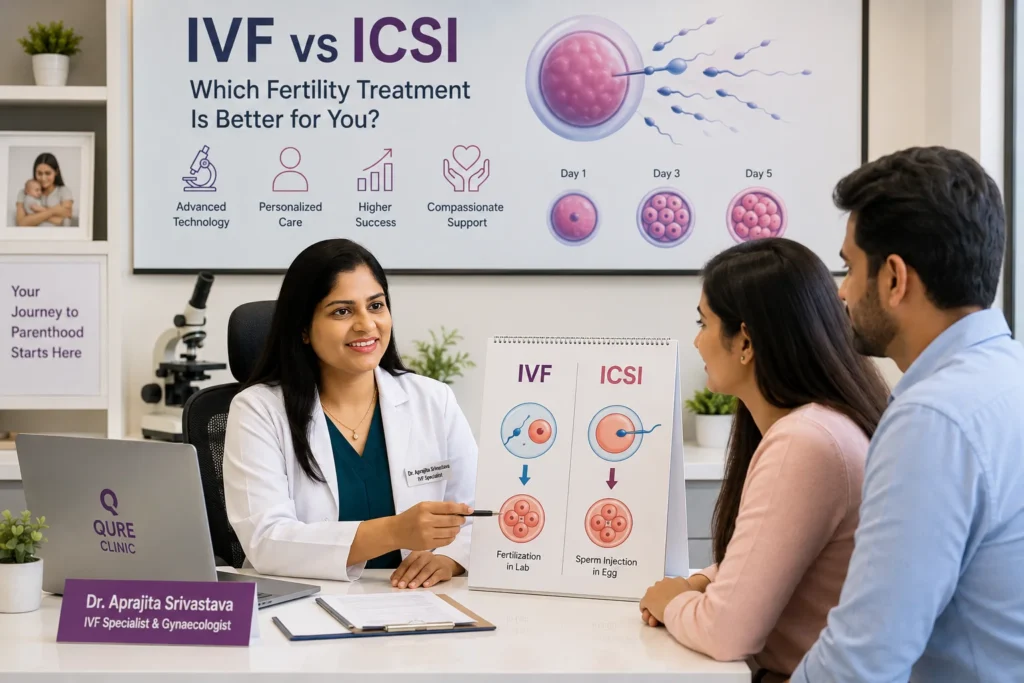
Dr. Aprajita Srivastava, a highly skilled gynecologist, IVF specialist, and laparoscopic surgeon in Noida, helps couples choose the most suitable fertility treatment based on their individual medical condition. With extensive experience in IVF, IUI, fertility preservation, and advanced reproductive medicine, she provides personalized fertility solutions for couples struggling with infertility.
What is IVF Treatment?
IVF (In Vitro Fertilization) is one of the most successful fertility treatments available today. During IVF, eggs and sperm are combined in a specialized laboratory, allowing fertilization to occur naturally outside the body.
After fertilization, the resulting embryos are monitored for several days. The healthiest embryo is then transferred into the uterus to achieve pregnancy.
Who Can Benefit from IVF?
- Women with blocked fallopian tubes
- Couples with unexplained infertility
- Women with ovulation disorders
- Patients with endometriosis
- Mild male factor infertility cases
- Women with age-related fertility decline
If you want to understand the complete IVF process, you can also read our guide on What Is IVF? Comprehensive Guide to Test Tube Baby Procedure.
What is ICSI Treatment?
ICSI (Intracytoplasmic Sperm Injection) is an advanced form of IVF. The procedure follows the same initial steps as IVF, including ovarian stimulation and egg retrieval.
However, during fertilization, an embryologist selects a single healthy sperm and injects it directly into the egg using a specialized microscopic needle.
This technique helps overcome fertilization barriers and significantly improves fertilization rates in male infertility cases.
Who Can Benefit from ICSI?
- Low sperm count
- Poor sperm motility
- Abnormal sperm morphology
- Previous failed IVF fertilization
- Surgically retrieved sperm
- Frozen sperm samples
You may also find our article on Should You Do ICSI with IVF? helpful when evaluating treatment options.
IVF vs ICSI: Key Differences
| Factor | IVF | ICSI |
|---|---|---|
| Fertilization Method | Sperm fertilizes egg naturally | Single sperm injected into egg |
| Best For | Female infertility and unexplained infertility | Male factor infertility |
| Sperm Quality Requirement | Moderate to good | Very low sperm count acceptable |
| Procedure Complexity | Standard | More advanced |
| Cost | Generally lower | Slightly higher |
| Fertilization Rate | Good | Often higher in male infertility cases |
IVF vs ICSI Success Rates
Many patients believe that ICSI automatically guarantees better pregnancy outcomes. This is not always true.
ICSI mainly improves fertilization rates. Pregnancy success depends on several additional factors, including embryo quality, uterine health, maternal age, hormonal balance, and implantation potential.
Research shows that when sperm quality is normal, IVF and ICSI often have similar pregnancy outcomes. However, in severe male infertility cases, ICSI may provide better fertilization success.
For more detailed information, visit our article on Understanding IVF Success Rates.
IVF vs ICSI for Male Infertility
Male infertility contributes to nearly half of infertility cases. Problems such as low sperm count, poor motility, and abnormal sperm shape can reduce the chances of natural conception.
In such cases, ICSI is often the preferred treatment because it bypasses many fertilization barriers.
Additional male fertility factors such as sperm DNA fragmentation may also influence treatment decisions.
You can learn more from our article on Male Factor Infertility Beyond Semen Analysis.
IVF vs ICSI for PCOS Patients
Women with PCOS often face challenges related to irregular ovulation and hormonal imbalance.
IVF can be highly effective for PCOS patients when ovulation induction and simpler fertility treatments have failed.
If significant male factor infertility also exists, ICSI may be added to improve fertilization outcomes.
Our guide on Is IVF Possible in PCOS? provides additional insights.
Silent Endometriosis and IVF Success
One often-overlooked cause of infertility is Silent Endometriosis. Unlike traditional endometriosis, Silent Endometriosis may not cause obvious symptoms but can still affect fertility.
It may impact egg quality, embryo development, implantation, and overall IVF outcomes.
Many women with unexplained infertility are later diagnosed with Silent Endometriosis after detailed fertility investigations.
Proper diagnosis and treatment can significantly improve IVF success rates.
Read more in our detailed guide on Silent Endometriosis and Its Impact on IVF Success Rates.
When is IVF the Better Choice?
IVF may be recommended when:
- Fallopian tubes are blocked
- Ovulation disorders are present
- Endometriosis affects fertility
- Unexplained infertility exists
- Sperm parameters are normal or mildly affected
When is ICSI the Better Choice?
ICSI may be recommended when:
- Sperm count is very low
- Sperm motility is poor
- Previous IVF fertilization failed
- Surgical sperm retrieval is required
- Severe male factor infertility is diagnosed
How Fertility Specialists Decide Between IVF and ICSI
The decision between IVF and ICSI is based on a complete fertility assessment.
Doctors evaluate:
- Female age
- AMH levels
- Ovarian reserve
- Semen analysis results
- Previous fertility treatment history
- Underlying reproductive conditions
Every fertility journey is unique. Personalized treatment planning often provides the best outcomes.
Why Consult Dr. Aprajita Srivastava?
Dr. Aprajita Srivastava is a trusted IVF Specialist in Noida, experienced gynecologist, and laparoscopic surgeon known for managing complex fertility cases. She specializes in IVF, ICSI, IUI, fertility preservation, recurrent IVF failures, and high-risk pregnancy management.
Her patient-focused approach combines advanced reproductive technology with individualized treatment planning to maximize pregnancy success.
Couples seeking fertility evaluation can consult Dr. Aprajita Srivastava at:
QURE Clinic
Office No. 143, 1st Floor, Cleo Street, Sector 121, Noida, Uttar Pradesh 201301
Phone: +91 95992 44575
Conclusion
When comparing IVF vs ICSI, neither treatment is universally better. The ideal choice depends on the underlying cause of infertility. IVF remains highly effective for many female infertility conditions and unexplained infertility cases. ICSI is often preferred when significant male infertility factors are present.
A comprehensive fertility evaluation can help determine the most appropriate treatment approach. Consulting an experienced fertility specialist ensures that your treatment plan is tailored to your specific needs, increasing your chances of achieving a successful pregnancy.