
Age plays a big role. Still, numbers matter more than assumptions. This guide explains IVF Success After 35 vs 40 using real data. No myths. No false hope. Just clarity.
Infertility feels overwhelming. Many couples ask one question: what are my real chances with IVF?
Why Age Matters in IVF Success Rates
Fertility changes with time. This is natural.
Egg quality declines with age. Also, egg quantity reduces. As a result, embryo quality may drop.
In addition, chromosomal abnormalities increase. This can affect implantation and pregnancy success.
So, age directly impacts IVF outcomes. However, it is not the only factor.
IVF Success Rate by Age (Real Data Breakdown)
Doctors track IVF outcomes by age groups. This gives a clearer picture.
IVF Success Rate at Age 30–34
At this stage, fertility is strong.
Success rate is around 50–60% per cycle. Egg quality remains high. Also, response to treatment is better.
Therefore, IVF works efficiently in this age group.
IVF Success Rate After 35
Fertility begins to decline slowly.
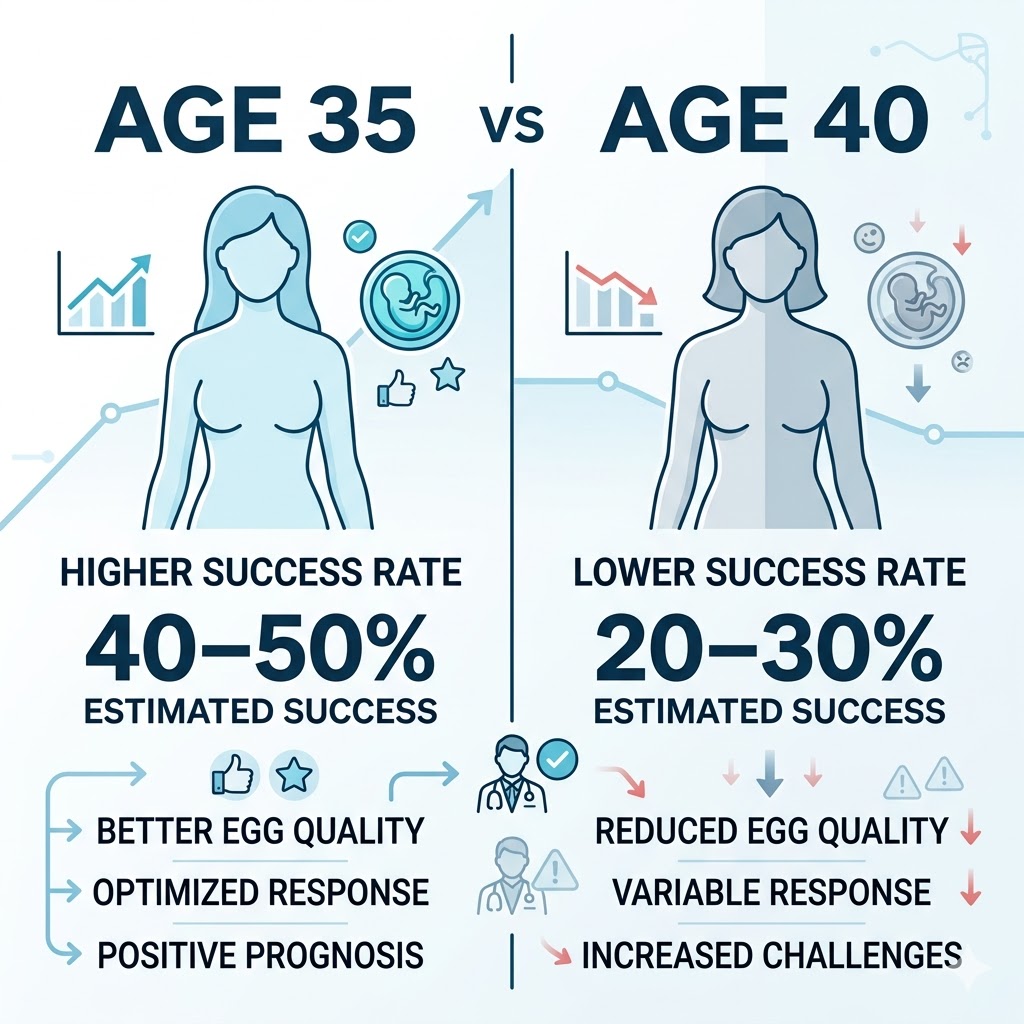
Success rate drops to 40–50% per cycle. Egg quality starts reducing. Still, chances remain good.
So, IVF Success After 35 is still promising. Early action improves outcomes.
IVF Success Rate After 40
Now the decline becomes sharper.
Success rate is around 20–30% per cycle. Ovarian reserve is lower. Also, embryo quality may be affected.
Thus, IVF Success After 40 is lower. However, success is still possible.
IVF Success Rate After 45 (Reality Check)
At this stage, chances are very low.
Success rate is less than 5% per cycle. Most cases require donor eggs.
Still, with the right approach, pregnancy can happen.
According to global clinical data, IVF outcomes vary significantly with age. You can review detailed statistics on the Society for Assisted Reproductive Technology IVF success rates by age
IVF After 35 vs 40 — Key Differences Explained
The difference is important. Even a few years matter.
At 35, egg quality is better. Also, fewer IVF cycles may be needed.
At 40, success rates drop. More cycles are often required.
In addition, the use of donor eggs increases after 40.
So, IVF Success After 35 vs 40 shows a clear gap. Early decisions make a difference.
Common IVF Myths After 35 and 40 (Debunked)
Misinformation creates fear. Let’s clear it.
Myth 1: IVF Guarantees Pregnancy
This is not true. IVF improves chances. It does not guarantee success.
Results depend on age, health, and embryo quality.
Myth 2: IVF After 40 Never Works
This is also false. Success is lower, but not zero.
Many women conceive after 40 with proper care.
Myth 3: One IVF Cycle Is Enough
In reality, multiple cycles may be needed.
Each cycle improves overall chances.
Factors That Influence IVF Success Beyond Age
Age matters. However, other factors also play a role.
- AMH levels show ovarian reserve
- Embryo quality affects implantation
- Lifestyle impacts fertility
- Clinic expertise improves outcomes
For accurate diagnosis and treatment, consulting an experienced infertility specialist in Noida can make a significant difference.
How to Improve IVF Success After 35 and 40
You can take steps to improve results.
- Start treatment early
- Maintain a healthy weight
- Avoid smoking and alcohol
- Follow medical advice strictly
Also, preparing your body before treatment helps. Here is a helpful guide to prepare for IVF treatment for better outcomes.
Advanced IVF Technologies Improving Outcomes
Modern IVF is evolving. Technology plays a big role.
AI-based embryo selection improves accuracy.
Genetic testing (PGT) reduces risks.
Better lab techniques increase implantation success.
Choosing the right facility also matters. A trusted IVF center in Noida can improve your chances significantly.
When Should You Consider IVF?
Timing is important.
After 35, consult a doctor if trying for 6 months without success.
After 40, do not delay. Early consultation is crucial.
Quick action improves success chances.
Realistic Expectations: IVF Is Not One-Size-Fits-All
Every case is different.
Some conceive in one cycle. Others need more time.
Data gives direction. Still, results vary.
So, stay informed and patient.
IVF Success After 35 vs 40 — Final Thoughts
At 35, chances remain strong.
At 40, chances reduce but are still possible.
The key is early action and expert guidance.
Therefore, informed decisions lead to better outcomes.
About Dr. Aprajita Srivastava
Dr. Aprajita Srivastava is a skilled gynecologist and IVF specialist based in Sector 121, Noida. She also specializes in laparoscopic surgery.
She has strong experience in infertility treatment. Her expertise includes IVF, IUI, and egg freezing.
In addition, she handles complex fertility cases and high-risk pregnancies.
If you are looking for expert guidance, you can consult the best gynecologist in Noida for personalized care.
Take the Next Step
If you are planning IVF, act early.
Consult a specialist. Understand your fertility status.
Make informed decisions based on real data.
You can also contact here to book your consultation.
Your journey to parenthood can start today.