Endometrial Thickness vs Receptivity: What Really Matters in IVF is a key question for couples undergoing fertility treatment. Many people focus only on thickness. However, implantation depends on more than just numbers.
You may have a good lining measurement. Still, implantation may fail. This happens because receptivity plays a bigger role.
Understanding this difference helps improve IVF success rates.
What is Endometrial Receptivity?
Endometrial receptivity refers to the short period when the uterus becomes ready for embryo implantation.
This phase is called the window of implantation. It depends on proper hormonal balance.
Estrogen prepares the lining. Progesterone makes it ready for implantation.
At the same time, blood flow, immune response, and cellular signals must work together.
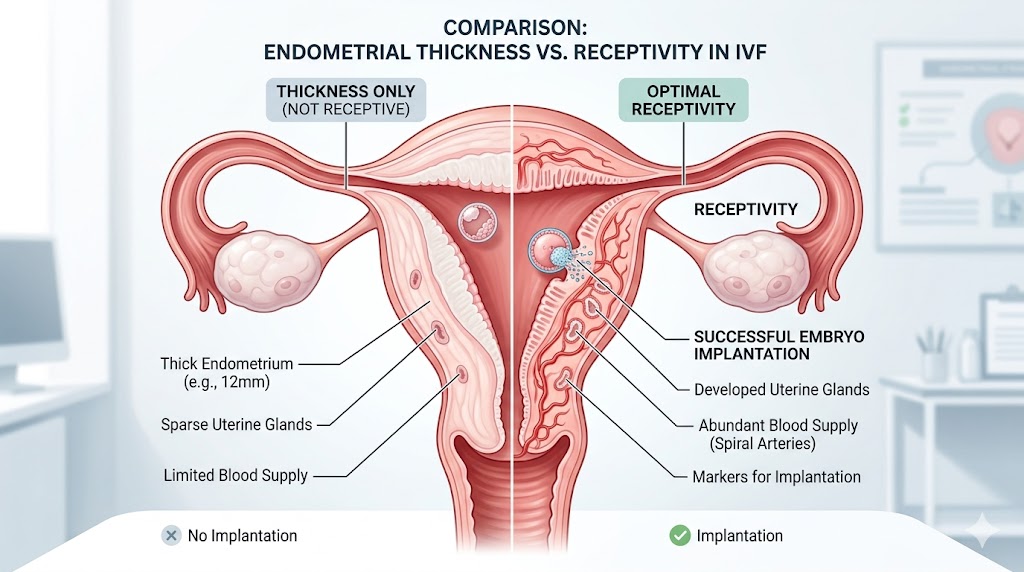
A receptive endometrium is not only thick. It must also be functionally ready.
Endometrial Thickness vs Receptivity: Understanding the Real Difference
Endometrial Thickness vs Receptivity: What Really Matters in IVF becomes clearer when we compare both factors.
Thickness refers to measurement in millimeters. It is visible on ultrasound.
Receptivity refers to biological readiness. It cannot be judged by thickness alone.
A lining of 8–10 mm is often considered ideal. However, pregnancies can occur even with thinner lining.
Therefore, thickness is only one part of the picture.
Fresh vs Frozen Embryo Transfer: Endometrial Considerations
Endometrial preparation differs in fresh and frozen cycles.
Fresh Embryo Transfer
In fresh cycles, embryo transfer happens in the same cycle as stimulation.
Hormone levels rise rapidly. This can affect receptivity.
Fresh transfer works well in selected cases. However, high estrogen levels may reduce implantation chances.
Frozen Embryo Transfer (FET)
Frozen cycles offer better control over the uterine environment.
Doctors can prepare the lining in a planned way.
This improves synchronization between embryo and endometrium.
Patients receiving treatment at an advanced IVF center in Noida often benefit from customized FET protocols.
Estrogen Protocols in Frozen Cycles
Estrogen can be given in different forms.
Oral tablets are commonly used. Some patients respond better to patches or gels.
In certain cases, injectable estrogen is required.
Each patient responds differently. Therefore, treatment must be personalized.
There is no universal protocol.
Thin Endometrium and Its Challenges
Thin endometrium remains a difficult issue in IVF.
A lining below 7 mm often raises concern.
Doctors may try different strategies to improve thickness.
These include extended estrogen therapy and medication changes.
Some patients may benefit from supportive therapies.
However, results vary from person to person.
Repeated failure requires proper evaluation instead of random treatments.
How Do We Assess Endometrial Receptivity?
Doctors use ultrasound to assess the lining.
Thickness is measured in millimeters. Pattern is also evaluated.
A trilaminar pattern is considered favorable.
However, implantation can still occur outside ideal values.
This shows that receptivity involves more than visible parameters.
If repeated failure occurs, consulting an experienced infertility specialist in Noida becomes important.
New Tests for Endometrial Receptivity: ERA and Beyond
ERA is a molecular test used to identify the implantation window.
It studies gene expression in the endometrium.
It may help in selected cases with repeated implantation failure.
However, it has limitations.
It is costly and invasive.
Results may vary between cycles.
According to current understanding, it should not be used routinely.
You can also review clinical insights on implantation from trusted sources like implantation process in IVF
The Bigger Picture in IVF Success
Endometrial Thickness vs Receptivity: What Really Matters in IVF depends on multiple factors.
Hormonal balance is essential. Blood flow must be adequate.
The immune system should support implantation.
Inflammation must remain controlled.
Most importantly, embryo and endometrium must be synchronized.
Focusing only on thickness can lead to incomplete treatment.
Conclusion
Endometrial Thickness vs Receptivity: What Really Matters in IVF highlights a critical truth.
A good lining does not guarantee success. A receptive lining does.
IVF success depends on timing, function, and balance.
A personalized approach always works better than generalized protocols.
Understanding the uterus is just as important as developing healthy embryos.
About Dr. Aprajita Srivastava
Dr. Aprajita Srivastava is a skilled fertility specialist known for treating complex IVF cases with a personalized approach.
She focuses on understanding both embryo quality and uterine receptivity to improve outcomes.
Her expertise includes IVF, endometrial assessment, and advanced fertility care.