
Ovulation timing is important for natural conception. Many women notice that their ovulation does not happen at the expected time. This raises concern about fertility.
Delayed ovulation does not always mean infertility. But it should not be ignored if it happens often.
This guide explains the basics clearly. It focuses on what delayed ovulation means and how it connects with fertility.
What Is Delayed Ovulation?
Ovulation is the release of an egg from the ovary. This usually happens once in every menstrual cycle.
In a regular cycle of 28 days, ovulation often occurs around day 14. But not all cycles follow this pattern.
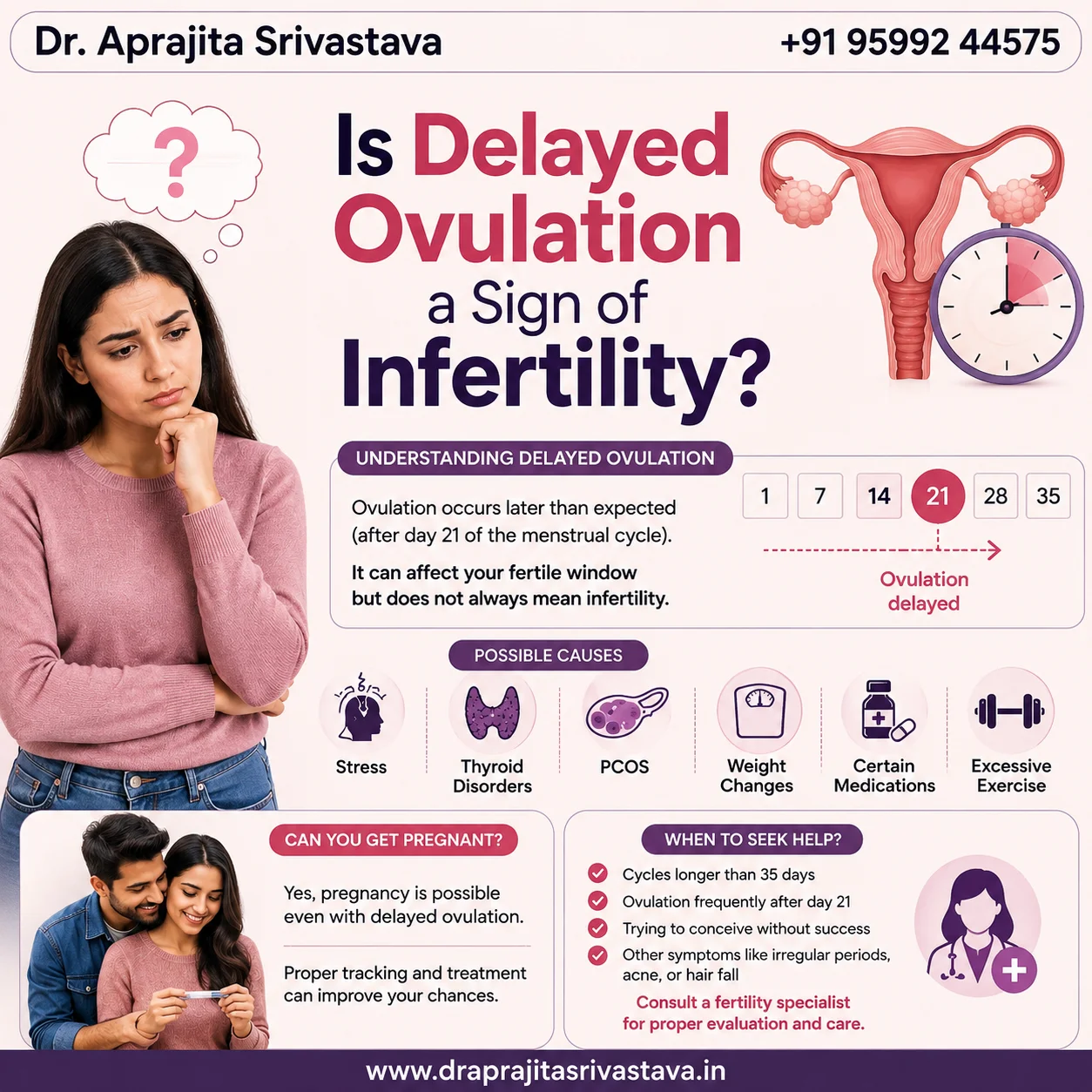
Delayed ovulation happens when the egg is released later than expected. This usually means ovulation occurs after day 21.
The delay is mostly linked to the follicular phase. This is the phase before ovulation. If this phase becomes longer, ovulation shifts later.
The second half of the cycle, called the luteal phase, usually stays stable. Because of this, a delayed ovulation often leads to a longer cycle.
Understanding the Menstrual Cycle
To understand delayed ovulation, it is important to know how the cycle works.
The menstrual cycle has four main phases.
1. Menstrual Phase
This phase starts on the first day of bleeding. Hormone levels drop. The uterus sheds its lining.
2. Follicular Phase
This phase begins along with menstruation. The brain releases FSH. This hormone helps follicles grow in the ovary.
One follicle becomes dominant. It prepares to release an egg.
3. Ovulation Phase
This is the most fertile phase. The ovary releases an egg. This usually happens mid-cycle.
In delayed ovulation, this phase happens later than expected.
4. Luteal Phase
This phase starts after ovulation. Progesterone increases. The uterus prepares for pregnancy.
If pregnancy does not occur, the cycle restarts.
You can explore more about cycle timing here: fertile days in the menstrual cycle.
Is Delayed Ovulation Always a Problem?
Not always.
Many women experience occasional delayed ovulation. This can happen due to stress, illness, or lifestyle changes.
In such cases, fertility is usually not affected.
The concern starts when delayed ovulation becomes frequent. It may indicate hormonal imbalance or irregular cycles.
Repeated delays can make ovulation unpredictable. This reduces the chances of timing intercourse correctly.
It may also point to conditions that affect fertility.
Read more about cycle-related concerns here: menstrual irregularities and their causes.
How Delayed Ovulation Affects Fertility?
Delayed ovulation does not always stop pregnancy. But it can make conception more difficult.
Fertility depends on timing, hormone balance, and egg quality. When ovulation is delayed, all three can be affected.
1. Irregular Timing of Fertile Window
Ovulation decides the fertile window. When ovulation shifts, the fertile days also shift.
This makes it harder to predict the right time for conception.
Couples may miss the optimal window without proper tracking.
2. Hormonal Imbalance
Ovulation depends on hormones like FSH and LH.
If these hormones are not released at the right time, ovulation gets delayed.
This imbalance can affect the development of the egg.
You can understand more about hormone-related fertility issues here: prolactin and fertility impact.
3. Egg Quality Concerns
In some cases, delayed ovulation may affect egg quality.
The egg may not mature properly if hormonal signals are inconsistent.
This can reduce the chances of successful fertilization.
However, this does not happen in every case.
4. Impact on Implantation
After ovulation, the uterus prepares for implantation.
If ovulation timing is irregular, the uterine lining may not be perfectly synchronized.
This can affect implantation in some cases.
Delayed Ovulation vs Anovulation
It is important to understand the difference.
- Delayed ovulation: Ovulation happens late.
- Anovulation: Ovulation does not happen at all.
Delayed ovulation still allows pregnancy. Anovulation makes natural conception difficult.
If cycles are very irregular, it is important to check if ovulation is happening at all.
When Delayed Ovulation Becomes a Concern?
Occasional delay is common. But repeated patterns need attention.
You should consider evaluation if:
- Your cycles are often longer than 35–40 days
- Ovulation happens very late in most cycles
- Periods are irregular or missed
- You have been trying to conceive without success
In such cases, early assessment helps identify the root cause.
Learn more about when to seek help: signs to visit a gynecologist.
Common Medical Causes Behind Delayed Ovulation
Several conditions can lead to delayed ovulation.
PCOS (Polycystic Ovary Syndrome)
PCOS is one of the most common causes.
It affects hormone balance and ovulation timing.
Women with PCOS often have irregular cycles.
Read more here: PCOS and fertility.
Thyroid Disorders
The thyroid gland affects metabolism and hormones.
Both high and low thyroid levels can delay ovulation.
High Prolactin Levels
Prolactin can suppress ovulation if elevated.
This is common in some hormonal conditions.
Weight and Lifestyle Factors
Sudden weight gain or loss can affect hormones.
Excessive exercise can also delay ovulation.
Chronic stress plays a major role as well.
You can explore how lifestyle affects fertility here: lifestyle and fertility connection.
Real-Life Situations
If your cycle is 35–40 days, ovulation may still occur. It just happens later.
If ovulation happens after day 25, tracking becomes more important.
If cycles are irregular with acne or weight changes, PCOS may be involved.
Each situation needs a different approach.
Diagnosis of Delayed Ovulation
If delayed ovulation happens often, proper evaluation is important.
The goal is to find the exact cause. Treatment depends on this.
Cycle Tracking
The first step is tracking your cycle.
This includes:
- Monitoring cycle length
- Tracking ovulation using kits
- Checking basal body temperature
Tracking helps confirm if ovulation is delayed or absent.
Hormone Testing
Doctors may recommend blood tests.
These include:
- FSH and LH levels
- Thyroid profile
- Prolactin levels
Hormones play a key role in ovulation timing.
Even small imbalances can delay ovulation.
Ultrasound Monitoring
Ultrasound helps track follicle growth.
It shows when the egg is maturing.
This method gives a clear picture of ovulation timing.
It is often used in fertility planning.
Ovarian Reserve Testing
Tests like AMH help assess ovarian reserve.
This gives an idea about egg quantity.
It is useful in long-term fertility planning.
You can learn more here: ovarian reserve and fertility planning.
Treatment Options for Delayed Ovulation
Treatment depends on the underlying cause.
In many cases, simple steps can help regulate ovulation.
Lifestyle Changes
Healthy habits can improve hormonal balance.
- Manage stress levels
- Maintain a healthy weight
- Follow a balanced diet
- Ensure proper sleep
You can explore natural approaches here: lifestyle changes for hormonal balance.
Medical Treatment
If lifestyle changes are not enough, medication may be needed.
Doctors may prescribe ovulation induction medicines.
These help stimulate egg release.
Hormonal therapy may also be used when required.
Advanced Fertility Treatment
If ovulation issues persist, assisted methods may be advised.
These include:
- IUI (Intrauterine Insemination)
- IVF (In Vitro Fertilization)
You can understand more about these options here: IVF treatment explained.
Each treatment plan is personalized based on the patient’s condition.
Natural Ways to Support Ovulation
Some natural steps can support regular ovulation.
These are not replacements for medical treatment but can help.
- Maintain a consistent routine
- Avoid extreme dieting
- Reduce caffeine and alcohol intake
- Practice stress management techniques
Balanced nutrition also plays a role.
Read more about diet and fertility: nutrition and fertility.
Myths and Facts About Delayed Ovulation
There is a lot of confusion around this topic.
- Myth: Delayed ovulation means infertility.
Fact: Many women conceive naturally. - Myth: Pregnancy is not possible.
Fact: Timing and tracking improve chances. - Myth: It is always caused by PCOS.
Fact: Many factors can delay ovulation.
Expert Insight
Delayed ovulation should be evaluated in context.
The frequency of delay and overall cycle health matter more than a single cycle.
Early diagnosis improves outcomes.
About Dr. Aprajita Srivastava
Dr. Aprajita Srivastava is a highly skilled gynecologist, IVF specialist, and laparoscopic surgeon based in Sector 121, Noida.
She has extensive experience in reproductive medicine and infertility care.
Her work includes IVF, IUI, and advanced fertility procedures.
Phone: +91 95992 44575
Address: Ofc No 143, 1st Floor, QURE CLINIC, Cleo St, Sector 121, Noida, Uttar Pradesh 201301
For consultation, visit: contact page.
Final Takeaway
Delayed ovulation is not always a sign of infertility.
But repeated delays should not be ignored.
Understanding the cause is the key to proper treatment.
Timely medical guidance improves the chances of successful conception.