
Dr. Aprajita Srivastava

Home » Blog
Gynecological Care

Fertility Challenges in Women with Autoimmune Thyroid Disease

Many women struggle with infertility without knowing the real cause. One often overlooked factor is autoimmune thyroid disease. This condition can affect hormone balance, ovulation, implantation, and pregnancy outcomes.

The thyroid gland plays an important role in reproductive health. It helps regulate metabolism, menstrual cycles, and hormone production. When the immune system attacks the thyroid gland, fertility problems can develop.…

Fertility Challenges in Women with Autoimmune Thyroid Disease Read Post »
Gynecological Care

The Science Behind Embryo Grading in IVF Treatment

Embryo grading is one of the most important steps in the IVF process. It helps fertility specialists identify embryos with the highest potential for implantation and pregnancy. Understanding The Science Behind Embryo Grading in IVF Treatment can help couples make informed decisions and set realistic expectations during their fertility journey.

Many patients assume that embryo grading guarantees IVF success. However, …

The Science Behind Embryo Grading in IVF Treatment Read Post »

Gynecological Care

How Sleep Disorders Affect Female Reproductive Hormones

Sleep is one of the most important pillars of women’s health. Yet, it is often overlooked. Many women focus on diet, exercise, and supplements while ignoring the impact of sleep on hormonal balance. Understanding how sleep disorders affect female reproductive hormones is essential for maintaining healthy menstrual cycles, fertility, pregnancy outcomes, and overall reproductive well-being.

Sleep and hormones share a …

How Sleep Disorders Affect Female Reproductive Hormones Read Post »

Gynecological Care

Recurrent Pregnancy Loss: Modern Diagnostic Approaches for Accurate Diagnosis and Better Pregnancy Outcomes

Experiencing a miscarriage can be emotionally overwhelming. When pregnancy loss happens repeatedly, it becomes even more distressing for couples trying to build a family. Recurrent Pregnancy Loss (RPL) affects physical health, emotional well-being, and future family planning decisions. While many couples fear they may never discover the cause, modern medical advancements have significantly improved the diagnosis and management of recurrent …

Recurrent Pregnancy Loss: Modern Diagnostic Approaches for Accurate Diagnosis and Better Pregnancy Outcomes Read Post »

IVF Specialist

IVF vs ICSI: Which Fertility Treatment Is Better for You?

Infertility affects millions of couples worldwide. Fortunately, modern fertility treatments offer effective solutions to help couples achieve their dream of parenthood. Among the most commonly recommended assisted reproductive technologies are IVF (In Vitro Fertilization) and ICSI (Intracytoplasmic Sperm Injection).

Many couples often wonder, “IVF vs ICSI: Which Fertility Treatment Is Better for You?” The answer depends on several factors, including …

IVF vs ICSI: Which Fertility Treatment Is Better for You? Read Post »

Gynecological Care

Can Lifestyle Changes Reverse Hormonal Imbalance Naturally?

Hormones play a major role in a woman’s overall health. They control metabolism, mood, sleep, fertility, menstrual cycles, and energy levels. When hormone levels become unbalanced, the body starts showing signs that something is wrong.

Many women ask, “Can lifestyle changes reverse hormonal imbalance naturally?” The answer is yes in many cases. Healthy habits can improve hormone function and reduce …

Can Lifestyle Changes Reverse Hormonal Imbalance Naturally? Read Post »

Gynecological Care

Role of Progesterone in Early Pregnancy and IVF Success

Progesterone is often referred to as the “pregnancy hormone” because of its vital role in establishing and maintaining a healthy pregnancy.

From preparing the uterine lining for implantation to supporting the developing embryo, progesterone is one of the most important hormones involved in conception.

The role of progesterone in early pregnancy and IVF success becomes even more significant during fertility …

Role of Progesterone in Early Pregnancy and IVF Success Read Post »

Gynecological Care

Ovarian Cysts: Which Types Affect Fertility the Most?

Ovarian cysts are fluid-filled sacs that develop on or inside the ovaries and are particularly common among women of reproductive age. In many cases, these cysts are harmless, cause no noticeable symptoms, and disappear naturally without treatment. However, some ovarian cysts can interfere with ovulation, affect hormone production, or impact the reproductive organs, making conception more difficult.

If you’re planning …

Ovarian Cysts: Which Types Affect Fertility the Most? Read Post »

IVF and Assisted Reproductive Technology

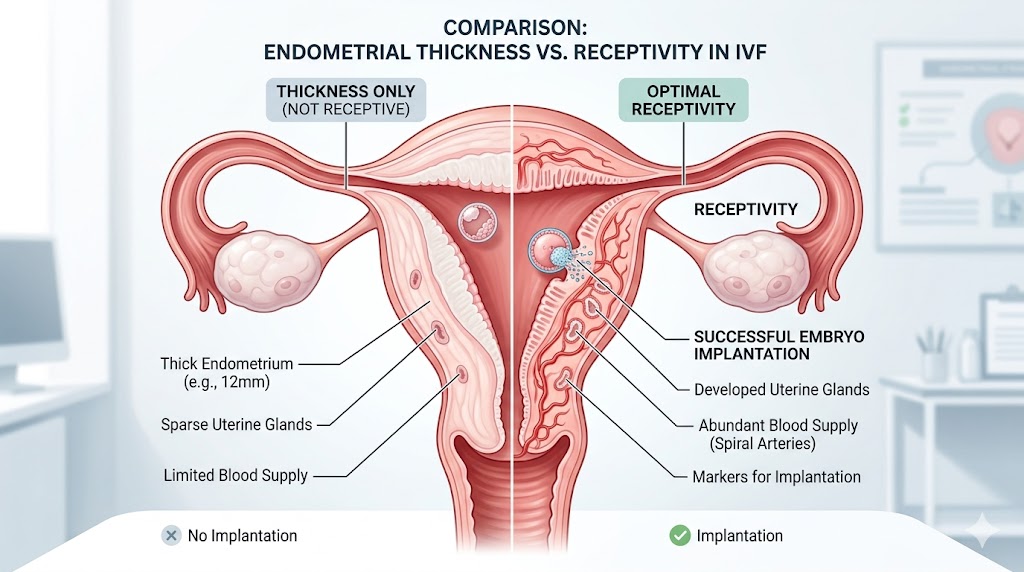
Endometrial Thickness vs Receptivity: What Really Matters in IVF

Endometrial Thickness vs Receptivity: What Really Matters in IVF is a key question for couples undergoing fertility treatment. Many people focus only on thickness. However, implantation depends on more than just numbers.

You may have a good lining measurement. Still, implantation may fail. This happens because receptivity plays a bigger role.

Understanding this difference helps improve IVF success rates.

Endometrial Thickness vs Receptivity What Really Matters in IVF showing implantation process

What

Endometrial Thickness vs Receptivity: What Really Matters in IVF Read Post »

IVF and Assisted Reproductive Technology

Low AMH, High FSH: Can IVF Still Work? Clinical Reality Explained

Low AMH, High FSH: Can IVF Still Work is a common question among women facing fertility challenges. Many couples feel confused after seeing their reports. They often assume that pregnancy is not possible.

However, that is not always true.

Even with low AMH and high FSH, pregnancy can still happen. The chances may reduce, but they do not disappear completely.…

Low AMH, High FSH: Can IVF Still Work? Clinical Reality Explained Read Post »

Scroll to Top